What Should You Do with Your Life? Directions and Advice
created: ; modified:I ask a lot of people about their life plans. At least half of them tell me that they have no idea where to move and are just coasting along, not sure what to do next. Therefore, this post.
What to work on?
- Y Combinator’s Requests for Startups
- Also see Jay Zaveri’s World’s Hardest Problems (via Gary Basin)
- José Luis Ricón’s (Artir) Technology some people are excited about
- Church Lab’s list of projects and of their implications (via Adam Marblestone)
- Also see Logan Collins’ Interesting Lab Websites in biology
- OpenAI’s Requests for Research
- Daniel Gross’s Markets To Build In (2019) (perma)
- Gwern’s project ideas
- Tyler Cowen’s project ideas, some of which he would like to fund himself
More ideas
- Patrick Collison’s questions.
- Gwern’s open questions. Also see /r/slatestarcodex discussion with 96 comments (best comment in the discussion)
- My research ideas.
- In my case, interesting ideas seem to almost always be a result of a collision of two trivial and unrelated ideas, allowed for by reading widely and writing a lot of thoughts down.
How to actually work on the problem you like?
- Write down a shortlist of problems that seem exciting
- Leave 1-3 most exciting and tractable problems via pairwise comparison of problems from the shortlist (like how tournaments decide on which team is the most “exciting”)
- Start learning everything you need to start working on the problem via
- MOOCs (edX has the absolute best ones, although you might want to simply google “how to learn x reddit”) and
- find a tutor
- email professors at your local university asking for help with specific problems
- MIT OCW (see MIT Challenge by Scott H. Young) and
- find a tutor
- email professors at your local university asking for help with specific problems
- See MOOCs I recommend
- Auditing classes at your local university
- Lambda School
- (you could also read textbooks instead of taking MOOCs, but I personally hate textbooks)
- (let me know if you know more great ways to learn!)
- MOOCs (edX has the absolute best ones, although you might want to simply google “how to learn x reddit”) and
- Start working on a project related to the problem
- Produce the minimal public impressive result
- Share it with people working in your area (cold emails and twitter are great for this! Actually, I should expand on that — see section below)
- If they like it, then you’re on the right track!
- If you’re in high school — try to go to summer schools in the field of your interest. You can also probably audit classes at a local university.
- If you’re in university and aren’t majoring in your favorite subject — you can still audit interesting classes and talk to professors and maybe go to summer schools.
Cold emails and twitter
Emailing people you don’t know can be shockingly effective.
There’s an unwritten rule that you shouldn’t do it, but if you actually provide value you can connect with almost anyone instantly and for free.
Cold emails and twitter are a godsend for people who have high potential, but lack the opportunity to realize it. A few emails or tweets to a person you don’t know can literally change your life (they changed mine for sure!)
If you can demonstrate that you have high potential and/or can be useful to somebody, you should just email/tweet them and let them know about it. If you’re thinking “well, I’m not impressive enough” you’re likely wrong.
Here are two examples of my cold emails that worked: first, second. It appears that 20-50% of cold emails end up getting answered and while the experience can be nerve-wrecking and confidence-destroying, ultimately, it pays off.
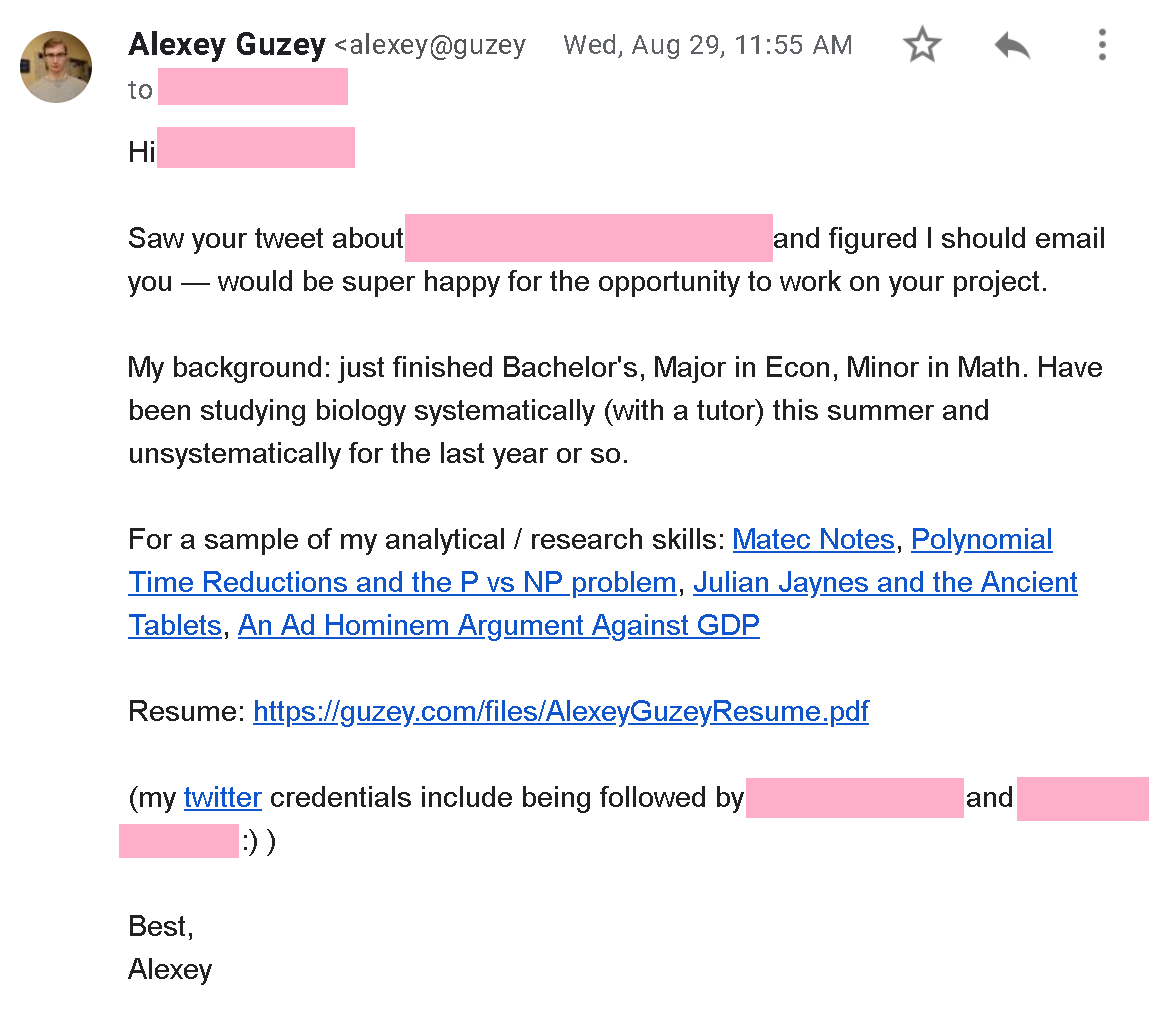
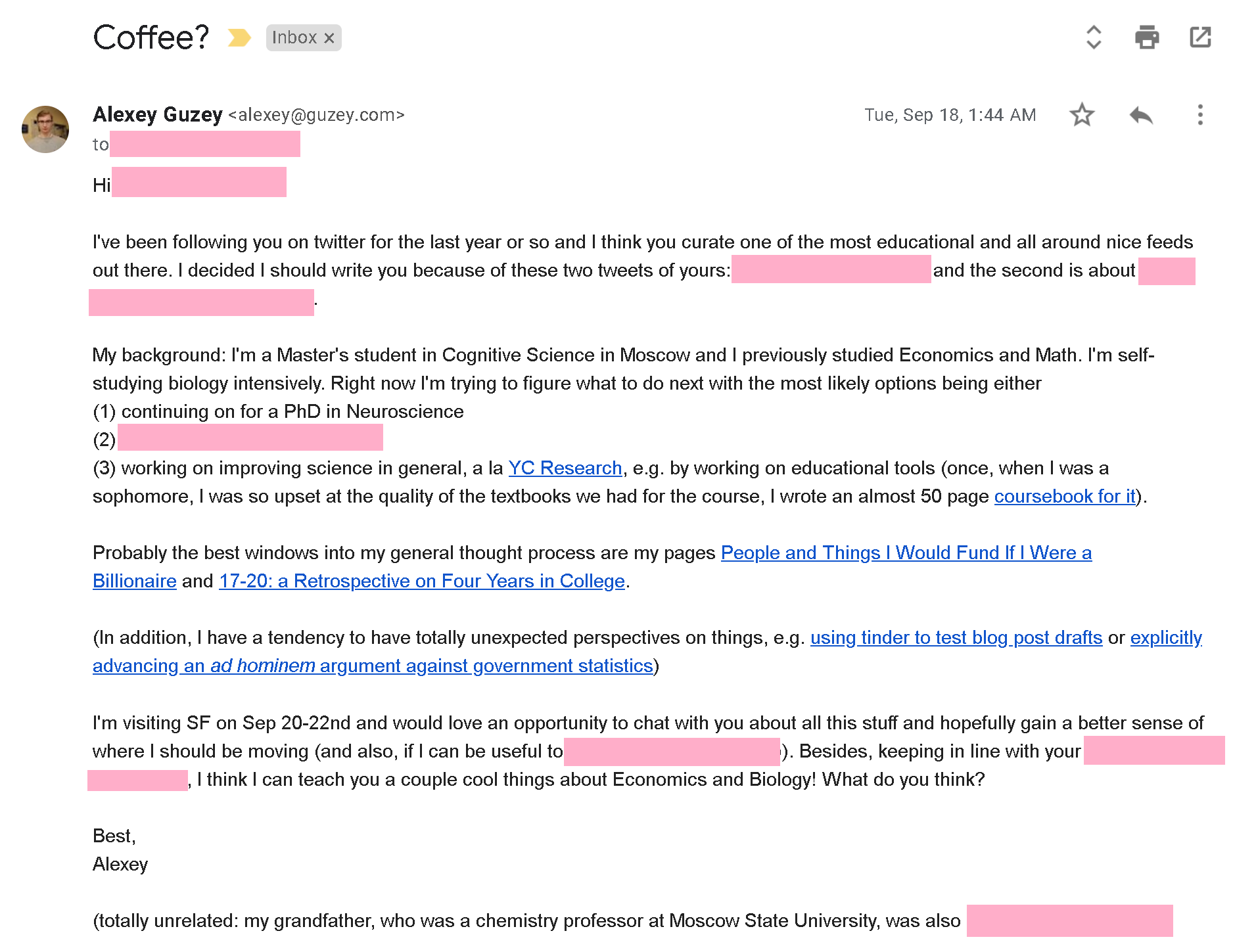
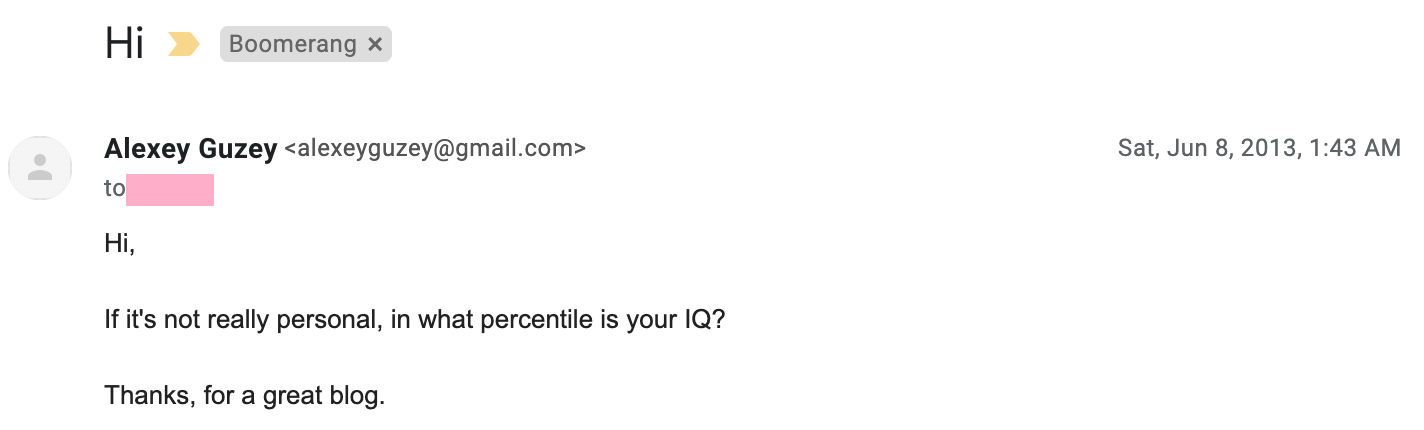
(if you think that I’m good at writing cold emails - it wasn’t always like that. e.g. here’s one I wrote when I was 19 to a professor in my university I didn’t know and here’s one that I wrote to someone on the internet when I was 15; I’m super embarrassed by them and I’m fortunate that I got replies)

Also see my How to make friends over the internet, Follow Up, Why You Should Join Twitter Right Now.
Where to find funding to work on any of these problems?
Many projects only require you to have a computer and some free time. Some actually require funding. For them, see:
-
Nadia Eghbal’s list of microgrants
-
Harshita Arora’s List of opportunities, grants, fellowship programs, contests and things like that for young ambitious people
-
Thiel Fellowship: $100,000 for people under 23 “who want to build new things instead of sitting in a classroom”
-
Einstein Fellowship is “a fellowship for outstanding young thinkers who wish to pursue a project in a different field from that of their previous research.”
-
Emergent Ventures “seeks to support entrepreneurs and brilliant minds with highly scalable, “zero to one” ideas for meaningfully improving society”
And if you’re starting a company, then you can try to get more conventional VC funding.
General Advice
How to Do What You Love by Paul Graham:
Another test you can use is: always produce. For example, if you have a day job you don’t take seriously because you plan to be a novelist, are you producing? Are you writing pages of fiction, however bad? As long as you’re producing, you’ll know you’re not merely using the hazy vision of the grand novel you plan to write one day as an opiate. The view of it will be obstructed by the all too palpably flawed one you’re actually writing.
“Always produce” is also a heuristic for finding the work you love. If you subject yourself to that constraint, it will automatically push you away from things you think you’re supposed to work on, toward things you actually like. “Always produce” will discover your life’s work the way water, with the aid of gravity, finds the hole in your roof.
Dive in by Nate Soares:
In my experience, the way you end up doing good in the world has very little to do with how good your initial plan was. Most of your outcome will depend on luck, timing, and your ability to actually get out of your own way and start somewhere. The way to end up with a good plan is not to start with a good plan, it’s to start with some plan, and then slam that plan against reality until reality hands you a better plan.
There’s no speed limit. by Derek Sivers:
But the permanent effect was this: Kimo’s high expectations set a new pace for me. He taught me “the standard pace is for chumps” — that the system is designed so anyone can keep up. If you’re more driven than “just anyone” — you can do so much more than anyone expects. And this applies to all of life — not just school.
Advice for ages 10-20 by Patrick Collison:
- To the extent that you enjoy working hard, do. Subject to that constraint, it’s not clear that the returns to effort ever diminish substantially. If you’re lucky enough to enjoy it a lot, be grateful and take full advantage!
- Make friends over the internet with people who are great at things you’re interested in. The internet is one of the biggest advantages you have over prior generations. Leverage it.
Career advice by /u/Kinoite:
Being at the Top of B-Tier will sufficient to get you a job. But, you’re probably screwed already. And, even if you’d gotten into a better school, trying to “Win” the Best-of-B-Tier competition is a stupid waste of time and money.
Instead, you want: (1) A professional accomplishment (2) that’s not part of your classes and (3) is acknowledged by a professional in your field.
So, I’ve invented The Working Resume™. It doesn’t list your academic credentials or any of your prior employers. It doesn’t show any of your past experience and it doesn’t list any jobs you ever did. No accomplishments, no achievements or awards. (Blasphemous, isn’t it?) So, what do you put on it?
- A clear picture of the business of the employer you want to work for.
- Proof of your understanding of the problems and challenges the employer faces.
- A plan describing how you would do the work the employer needs done.
- An estimate of what/how much you think you could add to the bottom line.
Things Many People Find Too Obvious To Have Told You Already by Patrick McKenzie:
Companies find it incredibly hard to reliably staff positions with hard-working generalists who operate autonomously and have high risk tolerances. This is not the modal employee, including at places which are justifiably proud of the skill/diligence/etc of their employees. …
Weak-form efficients market hypothesis is a good heuristic for evaluating the public markets but a really, really bad heuristic for evaluating either technical or economic facts about tech companies, startups, your career, etc etc. Optimizations are possible; fruit hangs low.
A Career Cold Start Algorithm by Andrew Bosworth
Don’t End The Week With Nothing (a) by Patrick McKenzie
I’ll close with my usual advice to peers: reading this email was valuable (knock on wood). Watching Jason’s video is valuable. Rolling up your sleeves and actually shipping something is much, much more valuable. If you take no other advice from me ever, ship something. You’ll learn more shipping a failure than you’ll learn from reading about a thousand successes. And you stand an excellent chance of shipping a success – people greatly overestimate how difficult this is.
Just don’t end the week with nothing.
See your Career as a Product (a):
Other product tropes also apply to careers: Capitalize on unfair advantages, insights, or relationships. Disrupt orthogonally, often from below—try not to compete head on. When you’re younger, take more market risk; when you’re more experienced, take execution risk.
However, certain mistakes product builders make also carry over to careers — namely, focusing on acquisition instead of retention (focusing on networking instead of relationships & reputation). Or working in a space that doesn’t get more valuable over time (e.g working in a dying industry), or building another “me-too” product without differentiation (not taking enough career risk).
“I often look at people’s achievements and think: I wish I’d done that. More rarely, I see the work that went into those achievements and think: I wish I were doing that. Chase the latter.” (a)
Even more general advice
All the evidence-based advice we found on how to be successful in any job by Benjamin Todd on 80,000 Hours
How to Maximize Serendipity by David Perell
HOWTO: Be more productive by Aaron Swartz
More projects to work on
Jacob Trefethen’s Vigilante accountability project